THCA percentage tells you how much tetrahydrocannabinolic acid a batch of flower contains by weight, and it’s the headline number on most menus. It isn’t the number to compare between two products. Total THC is, because it accounts for how much of that THCA will convert into THC when the flower is heated. A certificate of analysis lists THCA, delta 9 THC and total THC separately, and total THC is always the higher figure.
Key takeaways
Table of Contents
- THCA percentage is the raw cannabinoid content of the flower by weight.
- Total THC is the figure to compare, because it accounts for conversion when the flower is heated.
- Total THC is calculated from THCA and delta 9 THC together, so it’s always higher than THCA alone.
- A certificate of analysis lists all three figures separately. If a seller quotes one number and won’t show the certificate, that’s the problem, not the number.
- [EDITOR: insert the THCA range across the current TWS menu, and the total THC range, taken from your own certificates.]
- Percentage isn’t the whole story. Terpene content, and how the flower was grown, dried and cured, decide how it actually smokes.
What THCA percentage means
Every cannabis plant produces cannabinoids in an acidic form while it’s alive. The one that matters here is tetrahydrocannabinolic acid, or THCA. When a laboratory tests a batch of dried flower, it measures how much of the flower’s weight is made up of each cannabinoid it finds, and reports the result as a percentage.
So a batch listed at 24 percent THCA means that roughly a quarter of the dry weight of that flower is THCA. That’s the number most menus lead with, including ours, because it’s the number buyers ask for.
The catch is that THCA on its own isn’t what you experience. THCA has to be heated before it does anything, and the heating converts it into THC. That conversion is where the number on the label starts to matter less than people assume.
THCA against total THC, and why the second one matters
If you’re choosing between two jars, total THC is the fairer comparison. It’s an estimate of what the flower actually delivers once it has been smoked, vaped or baked, and it takes the conversion into account.
This matters most when two products look close on the headline figure. One batch at 23 percent THCA with very little delta 9 present can end up behind another at 22 percent THCA that carries more delta 9, once both are converted. Reading only the first number would have you choose the wrong one.
How total THC is calculated
Total THC combines the delta 9 THC already present in the flower with the share of THCA that converts when heated. Conversion is never complete, so the calculation applies a factor to the THCA figure rather than simply adding the two together. Different laboratories present it slightly differently, but they all arrive at the same idea: a single number estimating what you get in use.
You don’t need to do the arithmetic. Any certificate of analysis worth the name prints total THC as its own line. Find that line and compare it.
What counts as a high THCA percentage
Most flower on the market is sold on its THCA figure, and buyers generally treat the mid twenties and above as high potency. Below the high teens, most people would call it mild. That’s a market convention rather than a rule, and it moves as growing standards change.
It’s also worth knowing that a very high number isn’t automatically a better smoke, which is covered further down.
The range across our own menu
Across the flower we currently have in stock, THCA runs from 25 to 34 percent plus, and total THC from 20 to 25 percent plus.
Some of our current strains that would fall in to these ranges are:
- Reeses Pieces
- Ghost Train Haze
- Apple Jacks
- Captain Crunch
- Gumbo
This is just to name a few of the current strains we have available. Strains will come and go as farms decide to grow different strains so the strains we carry and which are available are always in flux.
How to read a certificate of analysis, section by section
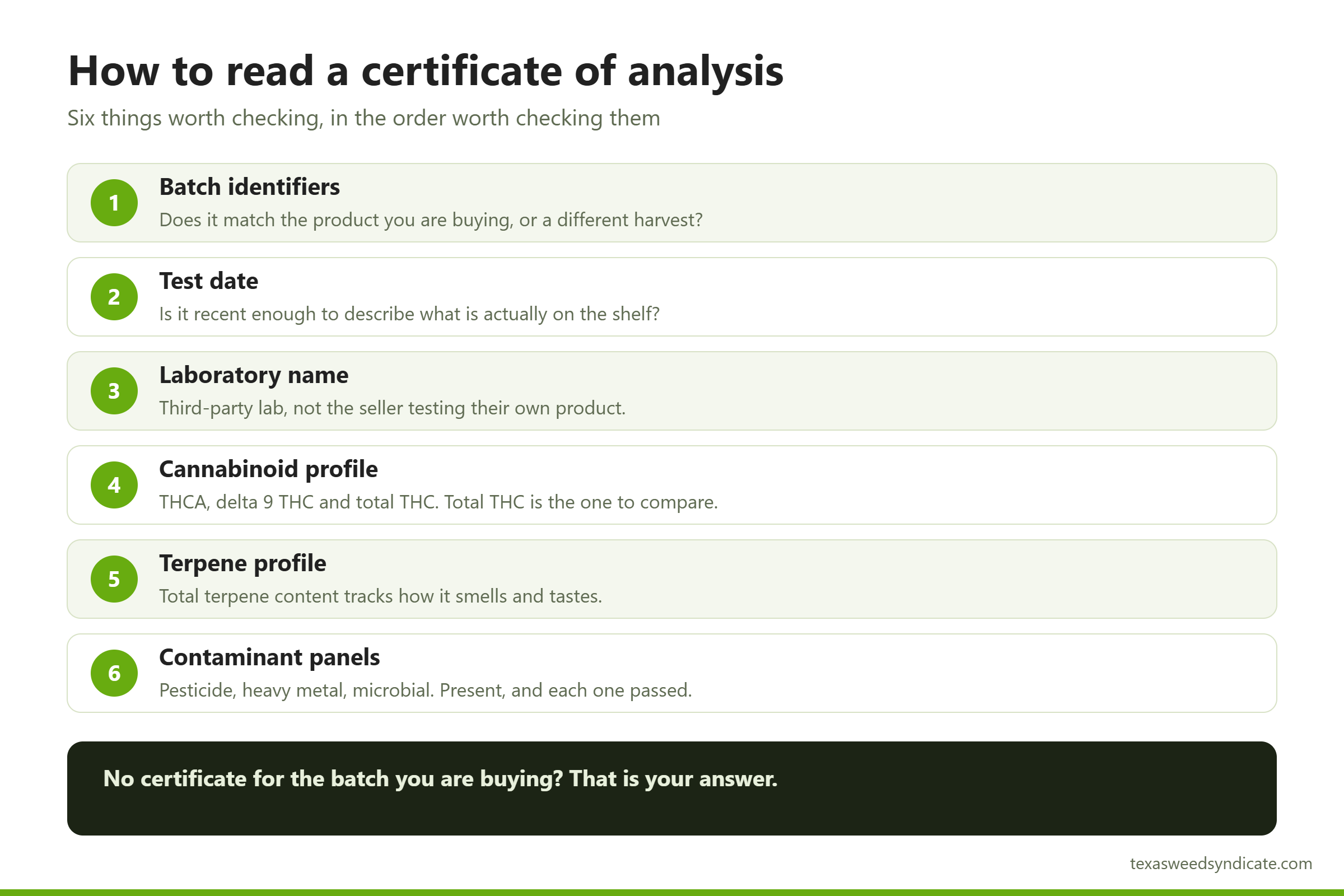
A certificate of analysis, usually shortened to COA, is the report from the independent laboratory that tested the batch. It isn’t marketing. It’s a test result, and it’s specific to one harvest of one strain.
Here is what to look at, in the order it’s worth looking.
| Section | What it tells you | What to check |
|---|---|---|
| Sample and batch identifiers (Sample Id) | Which specific batch was tested | That it matches the product you are buying, not a different harvest |
| Test date | When the sample was analyzed | That it is recent enough to describe what is on the shelf |
| Laboratory name and accreditation | Who ran the test | That it is a third-party lab, not the seller |
| Cannabinoid profile | THCA, delta 9 THC, total THC and minor cannabinoids | Total THC, and whether delta 9 sits within the legal limit |
| Terpene profile, if included | The aromatic compounds present | Total terpene content, which tracks closely with how good it smells and tastes |
| Contaminant panels, if included | Pesticide, heavy metal, microbial and residual solvent screening | That the panels are present and that each one passed |
If a seller can’t produce the certificate matching the batch you’re buying, the missing certificate is the answer to your question. Ours are published against the products they belong to.
Why the strongest number is not always the best flower
Potency is one variable out of several, and it’s the easiest one to print on a label. The things that decide whether flower is enjoyable are harder to quantify.
- Terpene content drives aroma and flavor. Two batches at the same THCA figure can smoke completely differently because one has three times the terpene content.
- How it was dried and cured decides whether it smokes smoothly or harshly. Rushed drying shows up immediately and no percentage compensates for it.
- How it was grown affects density, trim quality and appearance. Indoor, greenhouse and outdoor flower differ here more than they differ on cannabinoid content.
- Freshness matters. Flower degrades with light, heat and air, and an old jar at a high percentage can underperform a fresh one that tested lower.
The practical version: use total THC to narrow the shortlist, then choose on terpene content, appearance and how it was grown. If you want the detail on that last point, our comparison of greenhouse DEPS against indoor flower covers it properly.
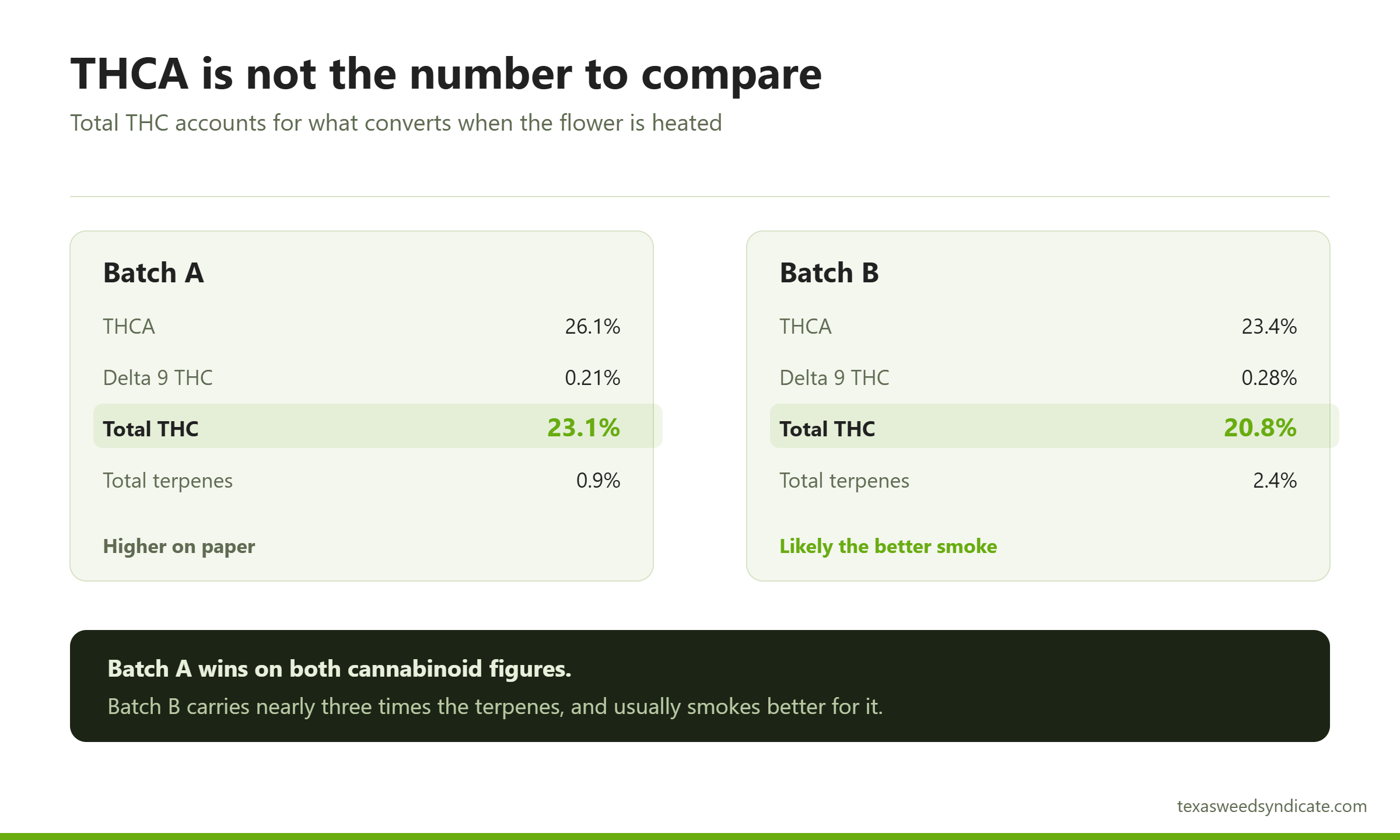
Comparing two products side by side
Here is the process in full, using two imaginary batches.
| Batch A | Batch B | |
|---|---|---|
| THCA | 26.1% | 23.4% |
| Delta 9 THC | 0.21% | 0.28% |
| Total THC | 23.1% | 20.8% |
| Total terpenes | 0.9% | 2.4% |
| Grown | Greenhouse | Indoor |
| Verdict | Higher on paper | Likely the better smoke |
Batch A wins on both cannabinoid figures. Batch B has nearly three times the terpene content, which in practice usually means a stronger nose, more flavor and a more distinctive effect. Plenty of experienced buyers would take B, and the label would have pointed them at A.
That’s the whole argument for reading past the headline number. When you’re ready to compare real ones, every batch of our exotic THCA flower lists its figures against the product.
Frequently asked questions
What is a good THCA percentage?
Most flower on the market is sold on its THCA figure, and buyers generally treat the mid twenties and above as high potency. The more useful comparison is total THC, since that is what you get once the flower is heated. [EDITOR: state the range across your own menu here, from your certificates, and say where it sits against the wider market.] A lower percentage with a strong terpene profile often smokes better than a higher one without.
Is THCA percentage the same as THC percentage?
No. THCA is the acidic form the plant produces, and THC is what it becomes when heated. A lab reports them separately, along with total THC, which combines them to estimate what the flower delivers in use. If a menu shows only one figure, check the certificate of analysis to see which one it’s quoting.
How is total THC calculated?
Total THC combines the delta 9 THC already present with the share of THCA that converts when heated. Conversion is never complete, so the calculation applies a factor rather than adding the two figures outright. The result is an estimate of what the flower delivers in use, which is why it’s the fairest number to compare between two products.
What is a COA and why should I ask for one?
A certificate of analysis is the report from the independent laboratory that tested the batch. It lists cannabinoid content, including THCA, delta 9 THC and total THC, and depending on the panel it may also cover terpenes and contaminant screening. It’s batch specific, so a certificate for one harvest doesn’t describe another. Any seller should be able to produce the one matching what you’re buying.
Where to go next
If you want to see the figures on real batches, they’re published against each product on our THCA flower for sale page. If you want the chemistry rather than the numbers, the difference between THCA and THC explains what is happening when the flower is heated.


