Yes, THCA flower can cause a positive result on a standard drug test. Screening tests don’t look for the cannabinoid you consumed, they look for THC metabolites, and because heating THCA converts it into THC, smoking or vaping THCA flower produces the same metabolite a standard screen is designed to find. The same applies to delta 8 and delta 9 products. If you’re subject to testing, the safe assumption is that any hemp THC product may show up.
The short answer, in plain terms
Table of Contents
If your job, your license or your legal situation depends on passing a drug test, hemp THC products aren’t a safe workaround. Not THCA flower, not delta 8, not hemp-derived delta 9.
This is the part of the category that gets misrepresented most often, usually by people selling it. Federal compliance and a negative test result are two completely unrelated things, and confusing them has cost people their jobs.
We sell THCA flower. We’d still rather you read this page and decided against buying than found out afterwards.
What a standard drug test actually looks for
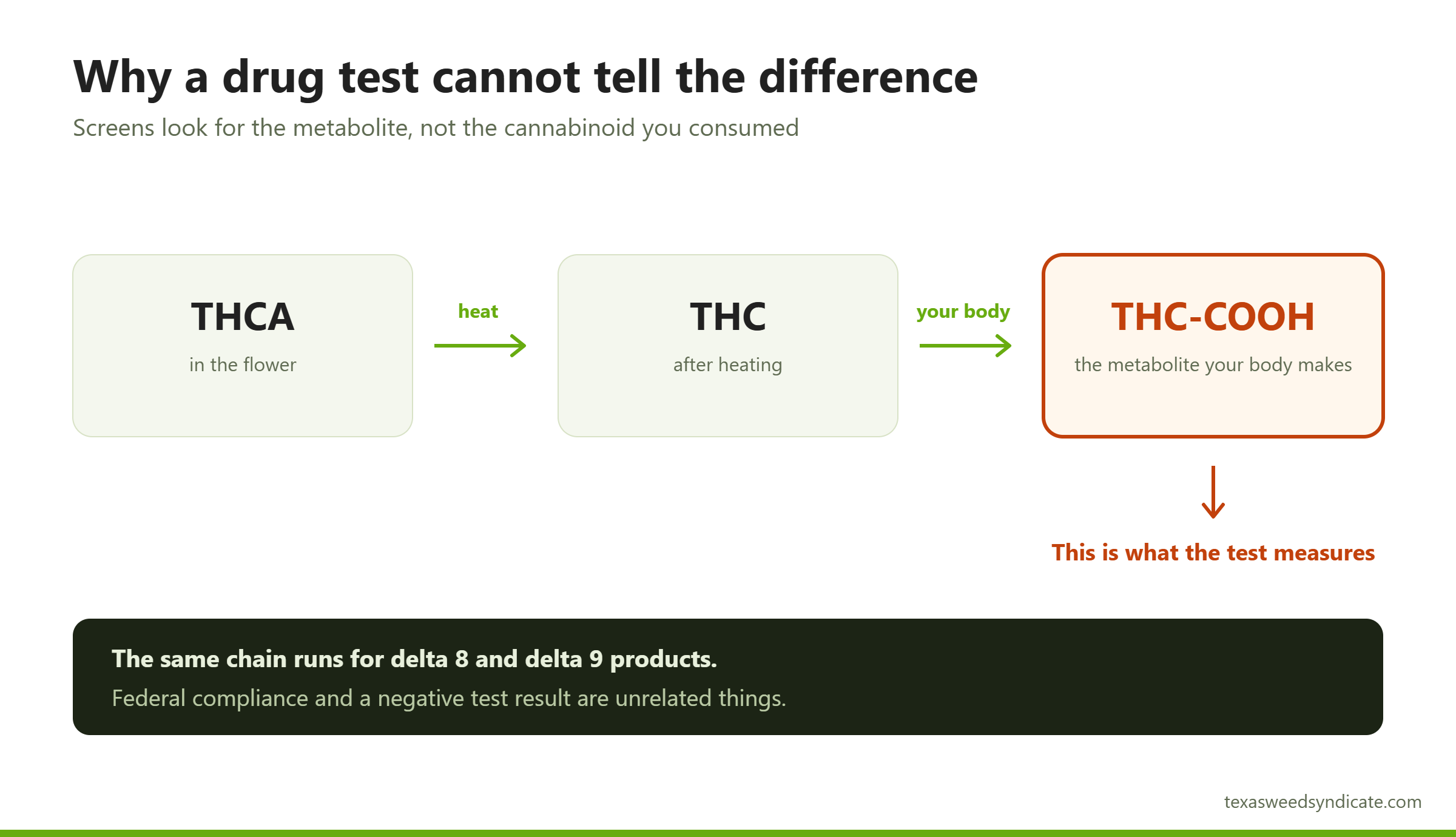
A workplace urine screen doesn’t test for THCA, or for delta 8, or even directly for delta 9 THC. It tests for metabolites, which are the compounds your body produces as it processes THC. The usual target is a metabolite called THC-COOH.
That single fact explains almost every question on this page. The test isn’t asking what you took. It’s asking whether the by-products of THC processing are present in the sample, above a set cutoff.
Why the cannabinoid you consumed is not what is measured
When you heat THCA, it converts to THC. Your body then processes that THC exactly as it would process THC from any other source, producing the same metabolites. By the time the sample reaches the laboratory, there’s nothing in it that distinguishes THC that started life as THCA in hemp flower from THC in anything else.
Delta 8 works similarly. Its metabolites are closely related to those of delta 9, and standard immunoassay screening isn’t selective enough to tell them apart reliably. A screen that returns THC positive doesn’t tell you which cannabinoid caused it.
THCA, delta 8 and delta 9 compared on this question
| Product | Can it trigger a positive screen? | Why |
|---|---|---|
| THCA flower, smoked or vaped | Yes | Heat converts THCA to THC, which metabolizes normally |
| THCA, raw and unheated | Less likely, but not a strategy | Without heat there is little conversion, though almost nobody consumes it this way |
| Delta 8 products | Yes | Metabolites are closely related to delta 9 and screens cannot reliably distinguish them |
| Hemp-derived delta 9 products | Yes | It is delta 9 THC. Compliance concerns concentration, not chemistry |
| CBD flower and CBD products | Generally not, but see below | CBD is a different compound. Trace THC in full spectrum products is the complication |
The CBD row deserves a note. Full spectrum CBD products legally contain trace delta 9 THC, and heavy or sustained use of them has been reported to produce positive screens. Broad spectrum and isolate products are formulated to remove it. If you’re tested, the distinction is worth understanding before you assume CBD is exempt.
How long it stays detectable
Any single number would be misleading. Detection windows vary enormously between individuals and situations, and anyone quoting one figure for everybody is guessing. The standard common answer is 4 to 6 weeks. This is not a exact number as there are too many factors to determine exactly how long it takes.
What changes the answer
- How much you consumed, and how strong it was.
- How often you consume. Occasional and daily use behave very differently, because THC metabolites accumulate in body fat and clear slowly.
- Your body composition and metabolism.
- Which test is used, and what cutoff that test is set to.
- How long ago the last use was, obviously, but in combination with everything above rather than on its own.
This is why a friend passing after a given number of days tells you almost nothing about whether you will.
The different test types and what each detects
Urine
What it detects: Not THC itself. It detects THC-COOH (carboxy-THC), an inactive metabolite the liver produces after THC is broken down. This is stored in fat and released slowly over time.
How it works: An initial immunoassay screen, typically at a 50 ng/mL cutoff. Anything non-negative goes to confirmation by GC-MS or LC-MS/MS, usually at a 15 ng/mL cutoff.
Typical detection window: Highly variable by individual, body fat, hydration and frequency of use. Commonly cited ranges:
- Single or infrequent use: roughly 1–3 days
- Moderate use (a few times a week): roughly 5–7 days
- Daily use: 10–15 days
- Heavy daily use: 30 days or more
What it can’t tell you: Nothing about impairment or when someone last used. A positive means past exposure, full stop.
Blood
What it detects: Parent delta-9-THC still circulating, plus metabolites including 11-OH-THC (active) and THC-COOH.
Typical detection window: THC blood levels peak within minutes of inhalation and drop steeply. Occasional users are often below common thresholds within 4–12 hours, sometimes up to 24–48 hours. Chronic heavy users can show measurable residual THC for days to weeks because of fat-stored release.
Where it’s used: DUI investigations, post-accident testing, clinical settings. It’s invasive and expensive, so it’s rarely a routine workplace screen.
Important caveat: Blood is the closest proxy for recent use, but researchers broadly agree blood THC concentration does not map reliably onto impairment the way blood alcohol does — particularly for regular users, who can carry levels that would exceed per se limits while not acutely impaired.
Saliva (Oral Fluid)
What it detects: Parent delta-9-THC deposited in the mouth and oral tissues. It’s mostly residue from smoking, vaping or ingestion rather than systemic circulation, which is why it correlates better with recent use.
Typical detection window: Roughly 4–24 hours for occasional use; up to 48–72 hours in frequent heavy users. Some studies show longer in chronic users.
Where it’s used: Roadside testing, reasonable-suspicion testing, and increasingly as a workplace alternative because collection is observed, non-invasive, and it flags recent rather than historical use. DOT rules were amended to permit oral fluid testing for federally regulated employees.
Hair
What it detects: THC and THC-COOH incorporated into the hair shaft from the bloodstream as hair grows.
Typical detection window: About 90 days using the standard 1.5-inch sample cut closest to the scalp (hair grows roughly 0.5 inch per month). Longer samples can extend the window.
Key quirks:
- There’s a blind spot of roughly 5–10 days at the near-scalp end — very recent use hasn’t grown out yet, so hair is bad at catching last week.
- External contamination from smoke or handling is a long-running point of contention. Accredited labs use decontamination washes and target THC-COOH specifically, since that metabolite can only come from inside the body.
- Hair testing has documented disparities in outcomes by hair type and treatment, which is part of why it’s used less in routine employment screening.
The point that matters most for hemp content
None of these tests distinguish the source of the cannabinoid. THCA converts to delta-9-THC when heated, and the body metabolizes it into the same THC-COOH a standard urine panel is looking for. Full-spectrum CBD products containing trace THC have also produced confirmed positives with sustained use. A standard panel returns “positive for THC metabolite” — it has no mechanism to certify the product was federally compliant hemp.
What this means if you are subject to testing
Straightforwardly: don’t use hemp THC products. That includes THCA flower, delta 8 and hemp-derived delta 9.
If you’re in a safety-sensitive role, hold a commercial driving license, are on probation, are in the military, or work anywhere with random screening, the risk isn’t worth the product. The legality of what you bought won’t be a defense, because the test doesn’t measure legality.
If you aren’t tested and never expect to be, none of this applies to you and you can ignore the whole page.
And if you’re somewhere in between, on the basis that you might be tested at some point, the honest advice is to assume detectability lasts longer than you would like and plan accordingly.
Frequently asked questions
Does THCA show up on a drug test?
It can. A standard screen looks for THC metabolites rather than for THCA itself, and heating THCA converts it to THC, so smoking or vaping THCA flower can produce a positive result. Raw, unheated THCA is a different case, but almost nobody consumes it that way. Treat a positive as the likely outcome if you’re tested.
Does delta 8 test positive for THC?
Commonly, yes. Standard immunoassay screens aren’t selective enough to distinguish delta 8 from delta 9, because both produce closely related metabolites. A test result that says THC positive doesn’t tell you which cannabinoid caused it, and the fact that a product is hemp-derived and federally compliant makes no difference to the screen.
How long does THCA stay in your system?
[EDITOR: sourced figures required. Give a range, state that it varies with dose, frequency, body composition and test type, and cite the source for each figure. Do not publish a single number. This question must not go live with this placeholder in it.]
Will a hemp-derived product pass a drug test because it is legal?
No. Legal status and test results are unrelated. A drug screen measures metabolites in a sample and has no way of knowing whether the product that produced them was federally compliant hemp or anything else. If your employment depends on a negative result, the legality of what you bought won’t help you.
Where to go next
If none of the above applies to you and you were only checking, our THCA flower is where to start. If you want to understand what is actually happening when THCA becomes THC, the difference between THCA and THC covers the chemistry.